Video transcript
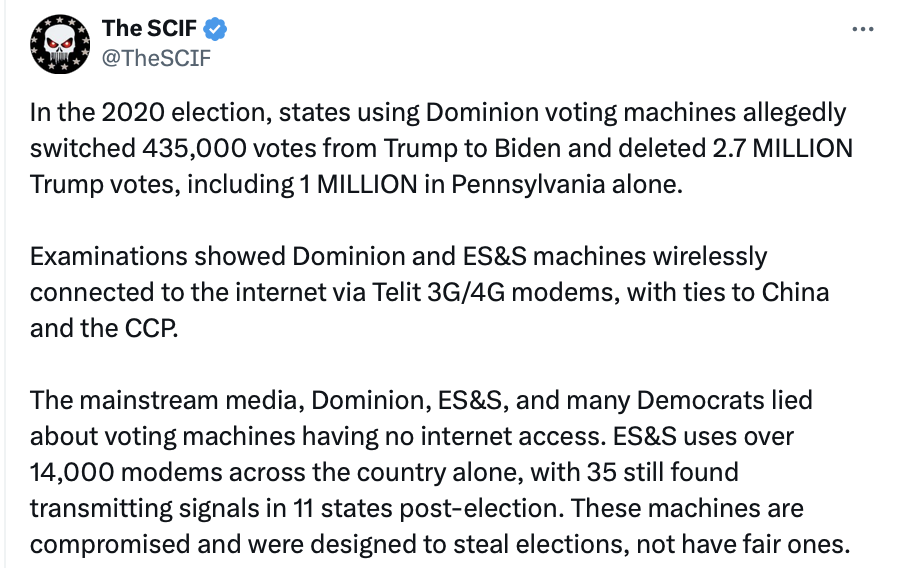
Election systems across the country are found to have deleted millions of votes cast for President Trump. According to an unaudited analysis of data obtained from Edison Research, states using Dominion voting systems may have switched as many as 435,000 votes from President Trump to Joe Biden. And the author also finds another 2.7 million Trump votes appear to have been deleted by Dominion, including almost 1 million Trump votes in Pennsylvania alone. The experts' claims are quite shocking and starkly contrast the narrative that we've heard. Media claims have been made that the machines were not connected to the internet, but according to the forensic report, that is patently false. The experts examined both Dominion and ES&S machines, and both were connected to the internet using wireless technology. This is a fact that the machine vendors knew well before the election, because their proposal to pitch for the contract included information about internet transmission and wireless capabilities. What is the vehicle for the transmission from the ICP? Is it cellular modem versus VPN? It is a cellular modem that can be configured in a VPN, right? And we currently in Chicago and Cook County, we work with Verizon to secure that network. So we would have the same capabilities here. What wireless chip set/modem does the hardware have? We support a variety. Some of the forensic evidence for this fact includes the wireless chip made by the company to LEAT. This is a picture from the forensic audit of the chip inserted into the machine to transmit information wirelessly. This is a clear admission that they knew the machines were connected to the internet and there were problems, so they had to tally manually. The media also claimed that there was no foreign involvement. But according to the forensic report, that is not true. The 4G card included in the ES&S machines, pictured here, was made by the company to LEAT. The project to manufacture the chips, according to the report, was funded by the Chinese and has ties to the Chinese Communist Party. Some have accused these companies of obfuscating and in some cases misleading election administrators and the American public. So I'd like to ask each of you, do you have components in your supply chain that come from either Russia or China? Chairperson, we do not have components that come from Russia. We do have a limited number of components that come from China. It wasn't our company in the entire report, but we do have components in our products that come from China. Ms. Mathis? Yes, similar feedback here. We take the security of our supply chain very seriously and we actively monitor and assess all aspects of that supply chain, including country of origin. So do you have components from China or Russia? We do not have components from Russia, but we do have, similar to my colleagues, we do have components. And what would be the nature of those components? Similar resistors, capacitors, they're the global supply chain for technology components of that. And what percentage do you know? I don't have. We'll follow up with that. Is there any method of voting that's 100% secure? No. No. No. Do you sell voting machines that have network capabilities installed? Can you be more specific? Yes, you don't have the software installed, but you have the capability of installing it. For remote access software? Yes. We do not. We no longer install any remote access software. That process was discontinued in 2006 and is not allowed by any of the EAC testing. We got a firsthand look when we visited ES&S, the largest manufacturer of voting machines, and talked to CEO Tom Burt. Why is there a sprint thing here and a Verizon thing here? There's a small percentage of jurisdictions in the country, a lot of them are in Florida, who have decided that they want to modem unofficial results to the election office. Voting machines are not connected to the internet. Those are not connected. Voting machines themselves are not connected to the internet. And we knew that wasn't true. And cybersecurity expert Kevin Skoglin wanted to prove it. So he and nine other independent security consultants created their own search engine looking for election systems online. We found over 35 had been left online and we're still continuing to find more. ES&S insists while there are 14,000 of its modems in use, there are firewalls separating those modems from the public internet and that the modems are turned on for just seconds. But Skoglin says that's not enough. We're seeing Illinois and Michigan. Last summer, Skoglin's team found ES&S voting systems online and at least some of the precincts in 11 states, including the battleground states of Florida, Michigan and Wisconsin. If you were able to get inside these systems, could you do more than perhaps mess up the preliminary results? Could you actually get deeper inside the system? Absolutely. And that's my biggest concern. Top computer scientist Andrew Appel agrees with Skoglin. Once the hackers starts talking to the voting machine through the modem, they can hack the software in the voting machine and make it cheat in future elections. In August, Skoglin took his results to election officials and the press, assuming the systems will get taken down. We were astonished when he showed us some of those systems are still online. Modems in voting machines are a bad idea. Those modems are network connections and that leaves them vulnerable to hacking by anybody who can connect to that network. We should make sure that voting machines are not connected to the internet. Period. Period. Mr. Pollis? Chairperson, we've never had any kind of remote access in our Dominion products. But I will say that I do want to draw a caveat. Some of our tabulators are designed around the ability to have an external plug-in modem to transmit unofficial results after it pulls close. Okay. What wireless chipset/modem does the hardware have? We support a variety. So it's really up to the jurisdictions what technology they want to use, what's compatible with their networks. Currently, some jurisdictions are using basically a modem that is a 3D modem, GSM, but we can support multiple varieties of modem. Including the latest 4D standards as well. So the answer is the next question is a 3D or 4G. Verizon, AT or T or Sprint, assuming all? Oh, yeah. All networks, right. Just to point it back, yeah. I mean, we actually transmit from the ICP in Mongolia as well, so we're not limited in networks. And in Puerto Rico, there's three vendors because the island is not covered by any of the vendors completely, so we use three different cellular vendors for some ICPs with this vendor, Maro, AT and T or T-Mobile, I think, in the different parts of the island. Analysts say the theft and destruction of votes are attributed to so-called glitches in Dominion Software and the extent to which this affected results can be verified by hand recounts of votes in each state.
Transcribed automatically. Expect errors in names and numbers.