Image 1
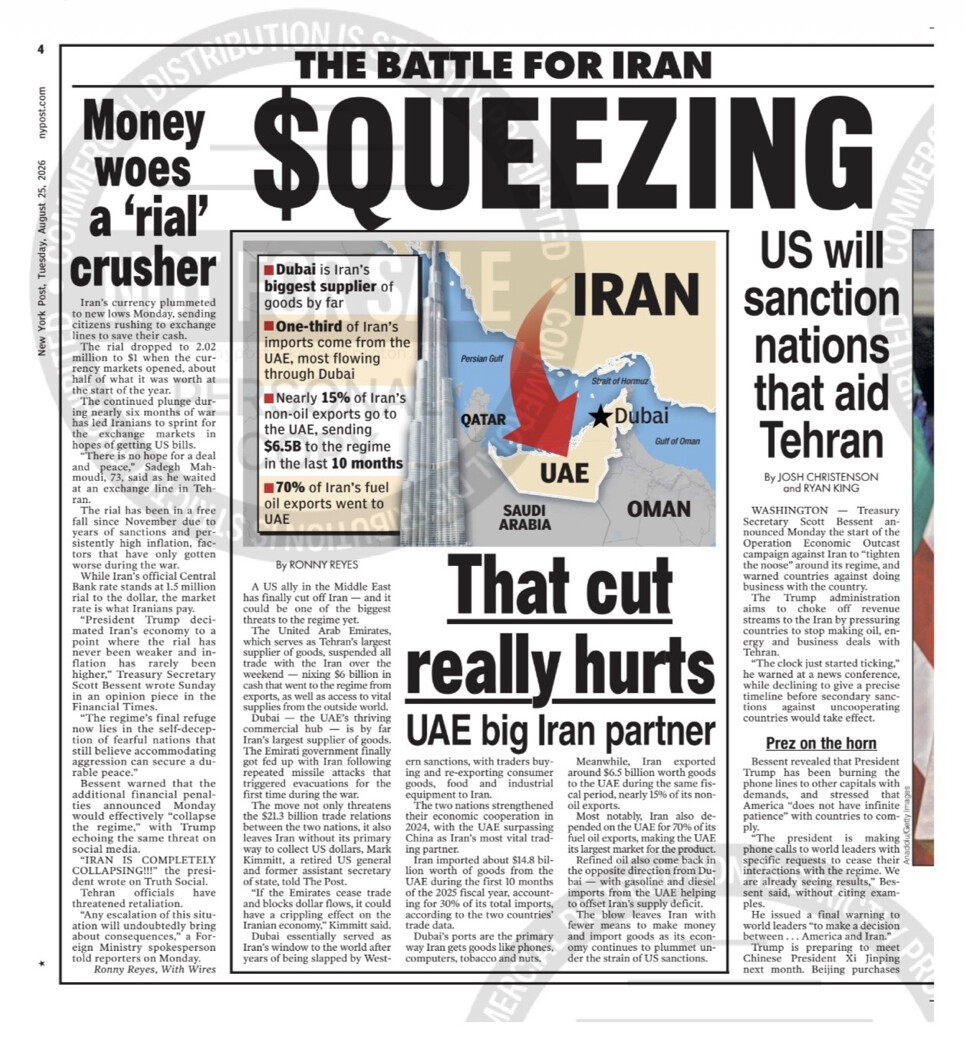
A scanned New York Post newspaper page (dated Tuesday, August 25, 2026) with the headline "THE BATTLE FOR IRAN / $QUEEZING" across the top. The page has three columns: a left story "Money woes a 'rial' crusher" about Iran's currency collapse, a center story with a map graphic of the Persian Gulf/UAE/Iran region showing a red arrow pointing into Iran, headlined "That cut really hurts / UAE big Iran partner," and a right story "US will sanction nations that aid Tehran" by Josh Christenson and Ryan King about Treasury Secretary Scott Bessent's "Operation Economic Outcast" campaign. A faint repeating watermark reading "COMMERCIAL DISTRIBUTION IS ..." overlays the page.
Text in image: 4 nypost.com New York Post, Tuesday, August 25, 2026 THE BATTLE FOR IRAN $QUEEZING Money woes a 'rial' crusher Iran's currency plummeted to new lows Monday, sending citizens rushing to exchange lines to save their cash. The rial dropped to 2.02 million to $1 when the currency markets opened, about half of what it was worth at the start of the year. The continued plunge during nearly six months of war has led Iranians to sprint for the exchange markets in hopes of getting US bills. "There is no hope for a deal or peace," Sadegh Mahmoudi, 73, said as he waited at an exchange line in Tehran. The rial has been in a free fall since November due to years of sanctions and persistently high inflation, factors that have only gotten worse during the war. While Iran's official Central Bank rate stands at 1.5 million rial to the dollar, the market rate is what Iranians pay. "President Trump decimated Iran's economy to a point where the rial has never been weaker and inflation has rarely been higher," Treasury Secretary Scott Bessent wrote Sunday in an opinion piece in the Financial Times. "The regime's final refuge now lies in the self-deception of fearful nations that still believe accommodating aggression can secure a durable peace." Bessent warned that the additional financial penalties announced Monday would effectively "collapse the regime," with Trump echoing the same threat on social media. "IRAN IS COMPLETELY COLLAPSING!!!" the president wrote on Truth Social. Tehran officials have threatened retaliation. "Any escalation of this situation will undoubtedly bring about consequences," a Foreign Ministry spokesperson told reporters on Monday. Ronny Reyes, With Wires ■ Dubai is Iran's biggest supplier of goods by far ■ One-third of Iran's imports come from the UAE, most flowing through Dubai ■ Nearly 15% of Iran's non-oil exports go to the UAE, sending $6.5B to the regime in the last 10 months ■ 70% of Iran's fuel oil exports went to UAE By RONNY REYES [Map showing IRAN, QATAR, Dubai (star), UAE, SAUDI ARABIA, OMAN, Persian Gulf, Strait of Hormuz, Gulf of Oman, with a red arrow pointing from the Gulf region into Iran] That cut really hurts UAE big Iran partner A US ally in the Middle East has finally cut off Iran — and it could be one of the biggest threats to the regime yet. The United Arab Emirates, which serves as Tehran's largest supplier of goods, suspended all trade with the Iran over the weekend — nixing $6 billion in cash that went to the regime from exports, as well as access to vital supplies from the outside world. Dubai — the UAE's thriving commercial hub — is by far Iran's largest supplier of goods. The Emirati government finally felt fed up with Iran following repeated missile attacks that triggered evacuations for the first time during the war. The move not only threatens the $21.3 billion trade relations between the two nations, it also leaves Iran without its primary way to collect US dollars, Mark Kimmitt, a retired US general and former assistant secretary of state, told The Post. "If the Emirates cease trade and blocks dollar flows, it could have a crippling effect on the Iranian economy," Kimmitt said. Dubai essentially served as Iran's window to the world after years of being slapped by Western sanctions, with traders buying and re-exporting consumer goods, food and industrial equipment to Iran. The two nations strengthened their economic cooperation in 2024, with the UAE surpassing China as Iran's most vital trading partner. Iran imported about $14.8 billion worth of goods from the UAE during the first 10 months of the 2025 fiscal year, accounting for 30% of its total imports, according to the two countries' trade data. Meanwhile, Iran exported around $6.5 billion worth of goods to the UAE during the same fiscal period, nearly 15% of its non-oil exports. Most notably, Iran also depended on the UAE for 70% of its fuel oil exports, making the UAE its largest market for the product. Refined oil also came back in the opposite direction from Dubai — with gasoline and diesel imports from the UAE helping to offset Iran's supply deficit. The blow leaves Iran with fewer means to make money and import goods as its economy continues to plummet under the strain of US sanctions. US will sanction nations that aid Tehran By JOSH CHRISTENSON and RYAN KING WASHINGTON — Treasury Secretary Scott Bessent announced Monday the start of the Operation Economic Outcast campaign against Iran to "tighten the noose" around its regime, and warned countries against doing business with Tehran. The Trump administration aims to choke off revenue streams to the Iran by pressuring countries to stop making oil, energy and business deals with Tehran. "The clock just started ticking," he warned at a news conference, while declining to give a precise timeline before secondary sanctions against uncooperating countries would take effect. Prez on the horn Bessent revealed that the President Trump has been burning the phone lines to other capitals with demands, and stressed that America "does not have infinite patience" with countries to comply. "The president is making phone calls to world leaders with specific requests to cease their interactions with the regime. We are already seeing results," Bessent said, without citing examples. He issued a final warning to world leaders "to make a decision between . . . America and Iran." Trump is preparing to meet Chinese President Xi Jinping next month. Beijing purchases
Described automatically. The words above are a machine's reading of the picture, not Trump's.
Image 2
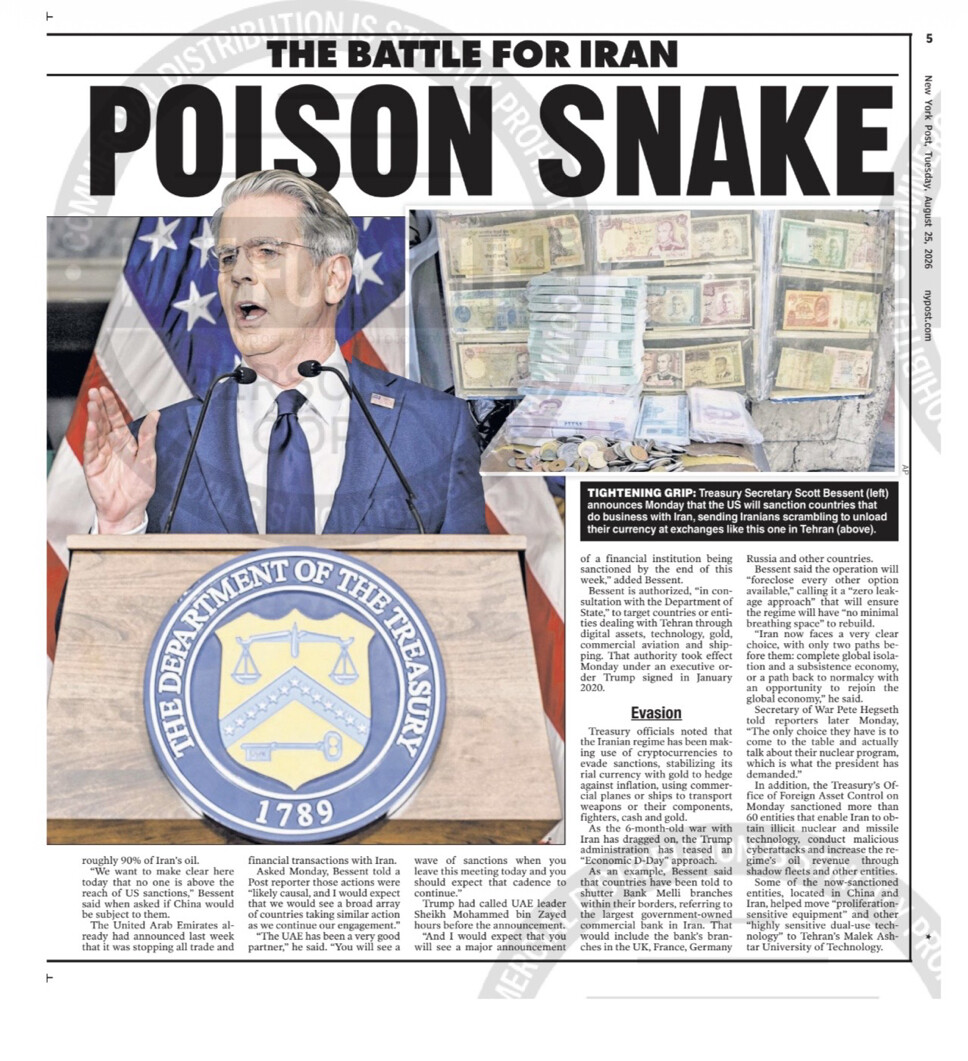
A New York Post newspaper page (page 5, dated "New York Post, Tuesday, August 25, 2026," nypost.com printed on the right margin) under the headline series "THE BATTLE FOR IRAN" / "POISON SNAKE." The main photo shows a gray-haired man in glasses and a navy suit speaking at a lectern bearing the seal of "THE DEPARTMENT OF THE TREASURY" (dated 1789), with an American flag behind him and two microphones in front. A smaller inset photo to the right shows stacks of foreign currency (banknotes and coins) spread out, apparently at a currency exchange. A caption box between the photos reads "TIGHTENING GRIP: Treasury Secretary Scott Bessent (left) announces Monday that the US will sanction countries that do business with Iran, sending Iranians scrambling to unload their currency at exchanges like this one in Tehran (above)." Below the images is a multi-column news article with a subheading "Evasion," discussing US sanctions on Iran, Treasury actions against banks (including Bank Melli), comments from Bessent and Secretary of War Pete Hegseth, and references to a six-month-old war with Iran and sanctions targeting entities in China and Iran tied to nuclear/missile technology. The image has a translucent circular watermark/stamp overlaid across it reading something like "...DISTRIBUTION IS ST... COMMERCIAL... PROHIBITED" (partially obscured).
Text in image: THE BATTLE FOR IRAN POISON SNAKE TIGHTENING GRIP: Treasury Secretary Scott Bessent (left) announces Monday that the US will sanction countries that do business with Iran, sending Iranians scrambling to unload their currency at exchanges like this one in Tehran (above). THE DEPARTMENT OF THE TREASURY 1789 New York Post, Tuesday, August 25, 2026 nypost.com 5 roughly 90% of Iran's oil. "We want to make clear here today that no one is above the reach of US sanctions," Bessent said when asked if China would be subject to them. The United Arab Emirates already had announced last week that it was stopping all trade and financial transactions with Iran. Asked Monday told a Post reporter those actions were "likely causal, and I would expect that we would see a broad array of countries taking similar action as we continue our engagement." "The UAE has been a very good partner," he said. "You will see a wave of sanctions when you leave this meeting today and you should expect that cadence to continue." Trump had called UAE leader Sheikh Mohammed bin Zayed hours before the announcement. "And I would expect that you will see a major announcement of a financial institution being sanctioned by the end of this week," added Bessent. Bessent is authorized, "in consultation with the Department of State," to target countries or entities dealing with Tehran through digital assets, technology, gold, commercial aviation and shipping. That authority took effect Monday under an executive order Trump signed in January 2020. Evasion Treasury officials noted that the Iranian regime has been making use of cryptocurrencies to evade sanctions, stabilizing its rial currency with gold to hedge against inflation, using commercial planes or ships to transport weapons or their components, fighters, cash and gold. As the 6-month-old war with Iran has dragged on, the Trump administration has teased an "Economic D-Day" approach. As an example, Bessent said that countries have been told to shutter Bank Melli branches within their borders, referring to the largest government-owned commercial bank in Iran. That would include the bank's branches in the UK, France, Germany Russia and other countries. Bessent said the operation will "foreclose every other option available," calling it a "zero leakage approach" that will ensure the regime will have "no minimal breathing space" to rebuild. "Iran now faces a very clear choice, with only two paths before them: complete global isolation and a subsistence economy, or a path back to normalcy with an opportunity to rejoin the global economy," he said. Secretary of War Pete Hegseth told reporters later Monday, "The only choice they have is to come to the table and actually talk about their nuclear program, which is what the president has demanded." In addition, the Treasury's Office of Foreign Asset Control on Monday sanctioned more than 60 entities that enable Iran to obtain illicit nuclear and missile technology, conduct malicious cyberattacks and increase the regime's oil revenue through shadow fleets and other entities. Some of the now-sanctioned entities, located in China and Iran, helped move "proliferation-sensitive equipment" and other "highly sensitive dual-use technology" to Tehran's Malek Ashtar University of Technology.
Described automatically. The words above are a machine's reading of the picture, not Trump's.