Image 1
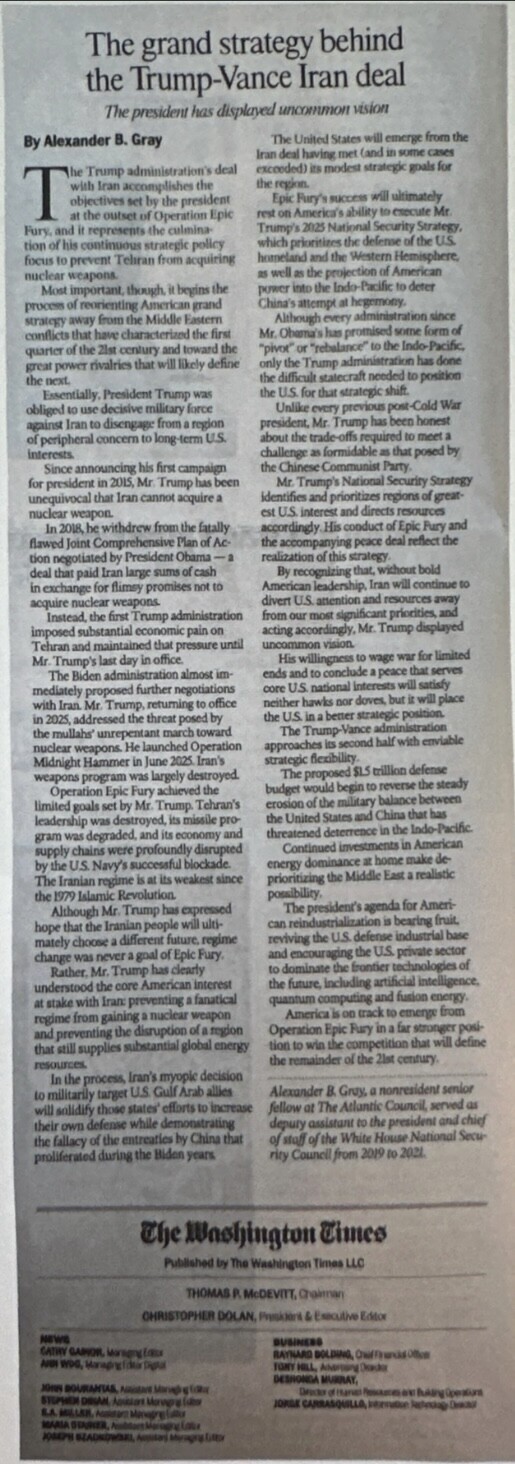
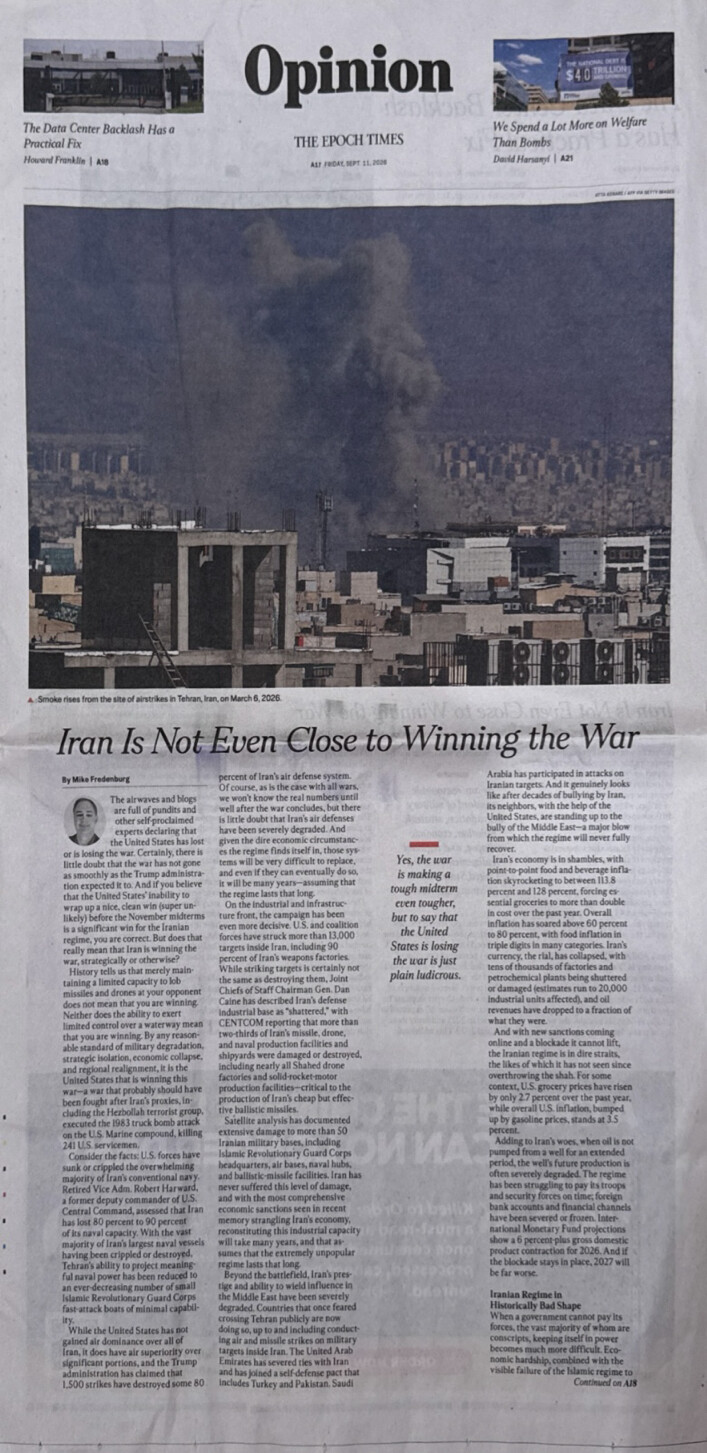
A photograph of a printed newspaper page from The Epoch Times' Opinion section, dated Friday, Sept. 11, 2026. At the top are two smaller linked headlines with thumbnail photos flanking the "Opinion" masthead: "The Data Center Backlash Has a Practical Fix" by Howard Franklin (A18) on the left, and "We Spend a Lot More on Welfare Than Bombs" by David Harsanyi (A21) on the right, the latter thumbnail showing a road sign reading "THE NATIONAL DEBT $40 [TRILLION]". Below is a large photo of a hazy, smoke-filled cityscape (buildings, an unfinished concrete structure with rebar and ladders in the foreground) captioned "Smoke rises from the site of airstrikes in Tehran, Iran, on March 6, 2026." Below that is the main opinion column headlined "Iran Is Not Even Close to Winning the War" by Mike Fredenburg, with a small circular author photo, a pull-quote in italics, and body text in three columns arguing that despite domestic political criticism, Iran's military and economy have been severely degraded and it is not winning the war against the U.S./Israel/coalition forces. A subheading "Iranian Regime in Historically Bad Shape" appears near the bottom of the third column, with "Continued on A18" at the very bottom.
Text in image: Opinion THE EPOCH TIMES A17 FRIDAY, SEPT. 11, 2026 The Data Center Backlash Has a Practical Fix Howard Franklin | A18 We Spend a Lot More on Welfare Than Bombs David Harsanyi | A21 [thumbnail sign text: THE NATIONAL DEBT $40 [TRILLION]] Smoke rises from the site of airstrikes in Tehran, Iran, on March 6, 2026. Iran Is Not Even Close to Winning the War By Mike Fredenburg The airwaves and blogs are full of pundits and other self-proclaimed experts declaring that the United States has lost or is losing the war. Certainly, there is little doubt that the war has not gone as smoothly as the Trump administration expected it to. And if you believe that the United States' inability to wrap up a nice, clean win (super unlikely) before the November midterms is a significant win for the Iranian regime, you are correct. But does that really mean that Iran is winning the war, strategically or otherwise? History tells us that merely maintaining a limited capacity to lob missiles and drones at your opponent does not mean that you are winning. Neither does the ability to exert limited control over a waterway mean that you are winning. By any reasonable standard of military degradation, strategic isolation, economic collapse, and regional realignment, it is the United States that is winning this war that probably should have been fought after Iran's proxies, including the Hezbollah terrorist group, executed the 1983 truck bomb attack on the U.S. Marine compound, killing 241 U.S. servicemen. Consider the facts: U.S. forces have sunk or crippled the overwhelming majority of Iran's conventional navy. Retired Vice Adm. Robert Harward, a former deputy commander of U.S. Central Command, assessed that Iran has lost 80 percent to 90 percent of its naval capacity. With the vast majority of Iran's largest naval vessels having been crippled or destroyed, Tehran's ability to project meaningful naval power has been reduced to an ever-decreasing number of small Islamic Revolutionary Guard Corps fast-attack boats of minimal capability. While the United States has not gained air dominance over all of Iran, it does have air superiority over significant portions, and the Trump administration has claimed that 1,500 strikes have destroyed some 80 percent of Iran's air defense system. Of course, as is the case with all wars, we won't know the real numbers until well after the war concludes, but there is little doubt that Iran's air defenses have been severely degraded. And given the dire economic circumstances the regime finds itself in, those systems will be very difficult to replace, and even if they can eventually do so, it will be many years—assuming that the regime lasts that long. On the industrial and infrastructure front, the campaign has been even more decisive. U.S. and coalition forces have struck more than 13,000 targets inside Iran, including 90 percent of Iran's weapons factories. While striking targets is certainly not the same as destroying them, Joint Chiefs of Staff Chairman Gen. Dan Caine has described Iran's defense industrial base as "shattered," with CENTCOM reporting that more than two-thirds of Iran's missile, drone, and naval production facilities and shipyards were damaged or destroyed, including nearly all Shahed drone production facilities and solid-rocket-motor production facilities—critical to the production of Iran's cheap but effective ballistic missiles. Satellite analysis has documented extensive damage to more than 50 Iranian military bases, including Islamic Revolutionary Guard Corps headquarters, air bases, naval hubs, and ballistic-missile facilities. Iran has never suffered this level of damage, and with the most comprehensive economic sanctions seen in recent memory strangling Iran's economy, reconstituting this industrial capacity will take many years, and that assumes the extremely unpopular regime lasts that long. Beyond the battlefield, Iran's prestige and ability to wield influence in the Middle East have been severely degraded. Countries that once feared crossing Tehran publicly are now doing so, up to and including conducting air and missile strikes on military targets inside Iran. The United Arab Emirates has severed ties with Iran and has joined a self-defense pact that includes Turkey and Pakistan. Saudi Yes, the war is making a tough midterm even tougher, but to say that the United States is losing is just plain ludicrous. Arabia has participated in attacks on Iranian targets. And it genuinely looks like after decades of bullying by Iran, its neighbors, with the help of the bully of the Middle East—a major blow from which the regime will never fully recover. Iran's economy is in shambles, with point-to-point food and beverage inflation skyrocketing to between 113.8 and 128 percent, forcing essential groceries to more than double in cost over the past year. Overall inflation has soared above 60 to 80 percent, with food inflation in triple digits in many categories. Iran's currency, the rial, has collapsed, tens of thousands of factories and petrochemical plants being shuttered or damaged (estimates run to 20,000 industrial units affected), and oil revenues have dropped to a fraction of what they were. And with new sanctions coming online and a blockade it cannot lift, the Iranian regime is in dire straits, the likes of which it has not seen since overthrowing the shah. For some context, U.S. grocery prices have risen by only 2.7 percent over the past year, while overall U.S. inflation, bumped up by gasoline prices, stands at 3.5 percent. Adding to Iran's woes, when oil is not pumped from a well for an extended period, the well's future production is often severely degraded. The regime has been struggling to pay its troops and security forces on time; foreign bank accounts and financial channels have been severed or frozen. International Monetary Fund projections show a 6 percent gross domestic product contraction for 2026. And if the blockade stays in place, 2027 will be far worse. Iranian Regime in Historically Bad Shape When a government cannot pay its forces, the vast majority of whom are conscripts, keeping itself in power becomes much more difficult. Economic hardship, combined with the visible failure of the Islamic regime to Continued on A18
Described automatically. The words above are a machine's reading of the picture, not Trump's.
Image 2
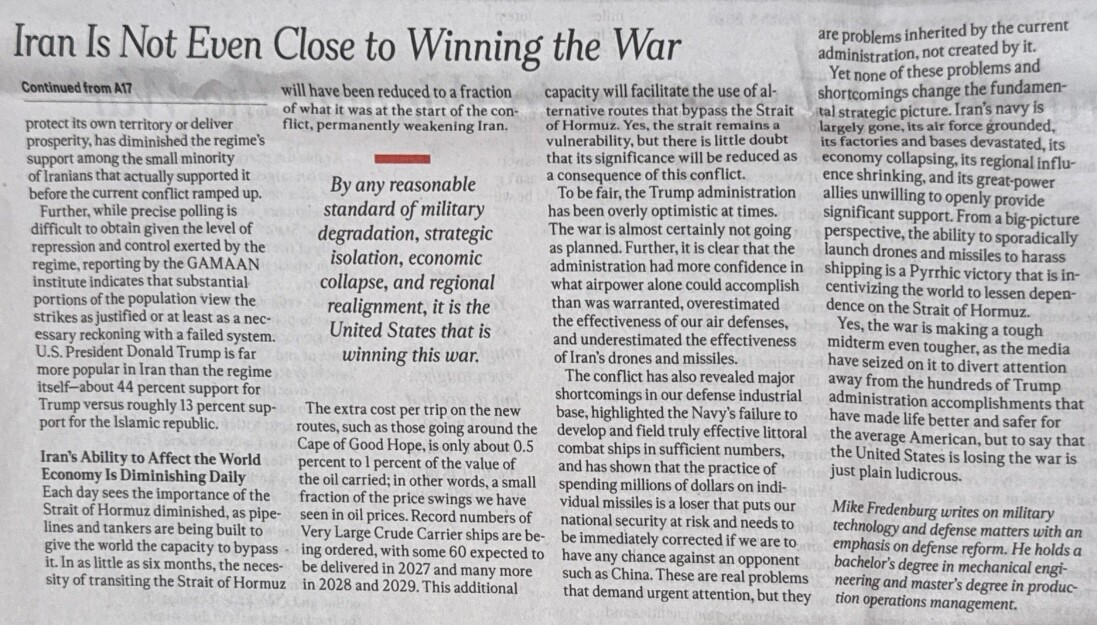
A screenshot of a newspaper/magazine opinion article continuation (marked "Continued from A17") headlined "Iran Is Not Even Close to Winning the War." The piece argues that despite setbacks, the U.S. and Trump administration are strategically winning against Iran, citing declining Iranian regime support, polling data, shipping route changes around the Strait of Hormuz, defense industrial base shortcomings, and media coverage framing. A pull-quote is set off in the middle column. An author bio at the end identifies the writer as Mike Fredenburg, who writes on military technology and defense matters.
Text in image: Iran Is Not Even Close to Winning the War Continued from A17 protect its own territory or deliver prosperity, has diminished the regime's support among the small minority of Iranians that actually supported it before the current conflict ramped up. Further, while precise polling is difficult to obtain given the level of repression and control exerted by the regime, reporting by the GAMAAN institute indicates that substantial portions of the population view the strikes as justified or at least as a necessary reckoning with a failed system. U.S. President Donald Trump is far more popular in Iran than the regime itself—about 44 percent support for Trump versus roughly 13 percent support for the Islamic republic. Iran's Ability to Affect the World Economy Is Diminishing Daily Each day sees the importance of the Strait of Hormuz diminished, as pipelines and tankers are being built to give the world the capacity to bypass it. In as little as six months, the necessity of transiting the Strait of Hormuz will have been reduced to a fraction of what it was at the start of the conflict, permanently weakening Iran. By any reasonable standard of military degradation, strategic isolation, economic collapse, and regional realignment, it is the United States that is winning this war. The extra cost per trip on the new routes, such as those going around the Cape of Good Hope, is only about 0.5 percent to 1 percent of the value of the oil carried; in other words, a small fraction of the price swings we have seen in oil prices. Record numbers of Very Large Crude Carrier ships are being ordered, with some 60 expected to be delivered in 2027 and many more in 2028 and 2029. This additional capacity will facilitate the use of alternative routes that bypass the Strait of Hormuz. Yes, the strait remains a vulnerability, but there is little doubt that its significance will be reduced as a consequence of this conflict. To be fair, the Trump administration has been overly optimistic at times. The war is almost certainly not going as planned. Further, it is clear that the administration had more confidence in what airpower alone could accomplish than was warranted, overestimated the effectiveness of our air defenses, and underestimated the effectiveness of Iran's drones and missiles. The conflict has also revealed major shortcomings in our defense industrial base, highlighted the Navy's failure to develop and field truly effective littoral combat ships in sufficient numbers, and has shown that the practice of spending millions of dollars on individual missiles is a loser that puts our national security at risk and needs to be immediately corrected if we are to have any chance against an opponent such as China. These are real problems that demand urgent attention, but they are problems inherited by the current administration, not created by it. Yet none of these problems and shortcomings change the fundamental strategic picture. Iran's navy is largely gone, its air force grounded, its factories and bases devastated, its economy collapsing, its regional influence shrinking, and its great-power allies unwilling to openly provide significant support. From a big-picture perspective, the ability to sporadically launch drones and missiles to harass shipping is a Pyrrhic victory that is incentivizing the world to lessen dependence on the Strait of Hormuz. Yes, the war is making a tough midterm even tougher, as the media have seized on it to divert attention away from the hundreds of Trump administration accomplishments that have made life better and safer for the average American, but to say that the United States is losing the war is just plain ludicrous. Mike Fredenburg writes on military technology and defense matters with an emphasis on defense reform. He holds a bachelor's degree in mechanical engineering and master's degree in production operations management.
Described automatically. The words above are a machine's reading of the picture, not Trump's.