11 posts from Thursday, June 11, 2026

← Back to Recent

Post from Truth Social

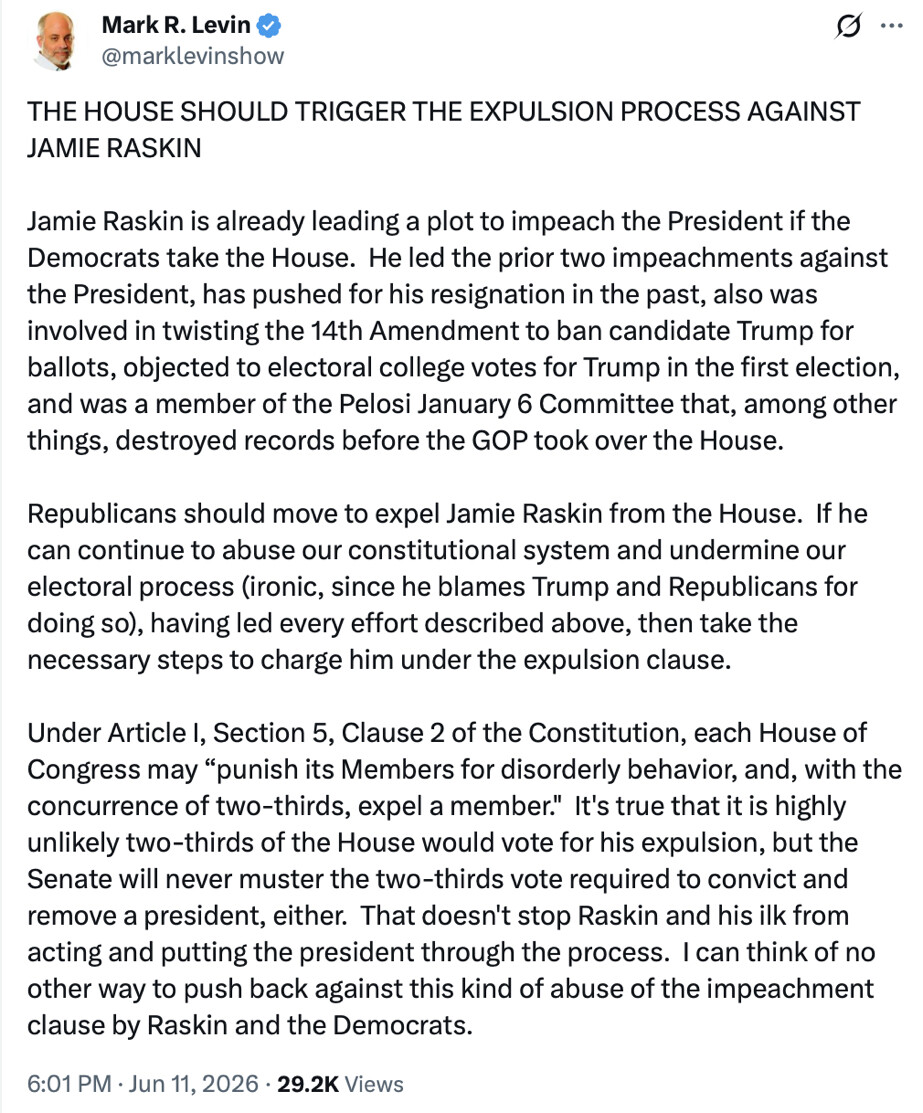
Jamie Raskin, a Loser in Life, who worked endlessly during my First Term to impeach me, and failed miserably, wasting the Country’s money, time, and effort, will guaranteed be trying to do it again, despite one of the most successful Presidencies in History. The last one that went after me on Impeachment was a pathetic soul, Al Green, who just lost his race in a landslide to an unknown candidate but, in my opinion, one that had more talent than Raskin. He spent time on the Unselect Committee of Political Hacks and Thugs, and was rebuffed on that, just as he has been rebuffed on Impeachment, and many other things. If Biden didn’t give him a pardon, he’d be in jail right now! Something should be done about people like this who do bad things, but always come up on the short end because of their illegal or unscrupulous behavior, and hurt our Country in the process. I agree with Mark Levin when he says to, EXPEL THE BUM. Congress can never be great with people like this, who suffer massively from Trump Derangement Syndrome (TDS), casting their vote of HATE! President DONALD J. TRUMP

Image attachment
0:00 0:00
Visualize
19.7K 5.8K 2K

Post from Truth Social

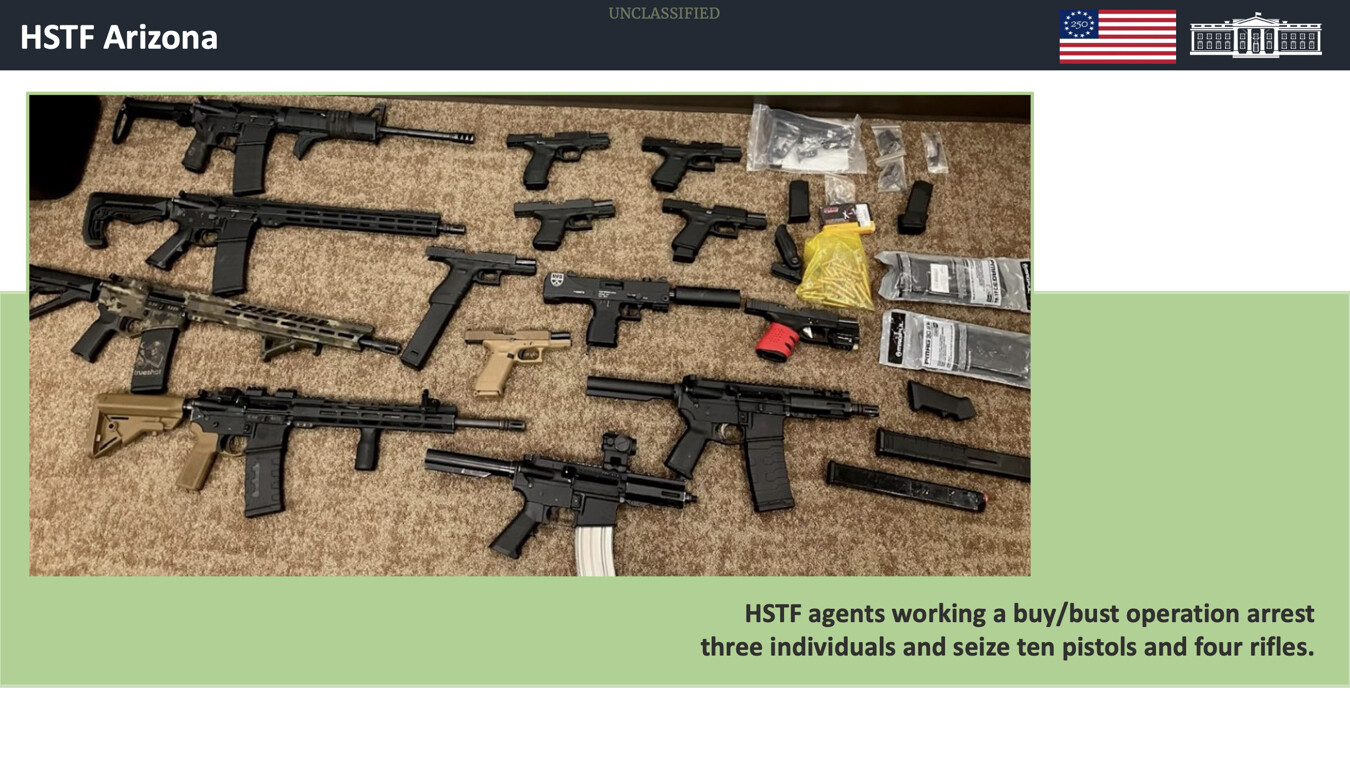
These are the weapons we are seizing from Mexican Cartels. They are killing thousands of Americans each and every year! President DONALD J. TRUMP

Image attachment
0:00 0:00
Visualize
20.1K 5.4K 1.5K

Post from Truth Social

I am pleased to announce the Nomination of very Highly Respected Jay Clayton, former Chairman of the Securities and Exchange Commission, the former Head of Sullivan & Cromwell, one of the most prominent and successful Law Firms anywhere in the World, and the current United States Attorney for the Southern District of New York, to be the next Director of National Intelligence and, importantly, to serve in my Cabinet. Few people anywhere in the Legal Community are respected at the level of Jay. I encourage the United States Senate to confirm Jay as soon as possible. Thank you for your attention to this matter! President DONALD J. TRUMP

0:00 0:00
Visualize
27K 6.1K 1.8K

Post from Truth Social

Based on the fact that discussions with the Islamic Republic of Iran have been brought to the highest level of Iranian leadership and approved, I have, as President of the United States of America, cancelled the scheduled strikes and bombings against Iran this evening. Discussions and final points have been, in both concept and great detail, approved by all parties involved, including the United States, Israel, Saudi Arabia, UAE, Qatar, Turkey, Pakistan, Bahrain, Kuwait, Jordan, Egypt, and others. The Naval Blockade will remain in full force and effect until this Transaction is finalized — Time and place of the signing to be announced shortly.

DONALD J. TRUMP
PRESIDENT OF THE UNITED STATES OF AMERICA

0:00 0:00
Visualize
38.9K 9.6K 13.2K

Post from Truth Social

The United States of America cannot live with the shackles of Birthright Citizenship. It is not economically, or otherwise, sustainable, and no other Country in the World, of consequence, does it! President DJT

0:00 0:00
Visualize
44.3K 11.1K 4K

Post from Truth Social

Deleted

RT @realDonaldTrump

Reposted
Video transcript reposted clip · 11:02

Let's head out to Tel Aviv where Trey Yanks is standing by after speaking with the president hours ago multiple times, including when the president was in the situation room. So, Trey, is it your understanding that there's a three-day plan, a four-day plan, or is it we're going to hit you until we get you back to the table plan? Yeah, Brian, good morning. My understanding is that there's a new equation for the Iranians because they were unwilling to make a good faith deal at the negotiating table. And I asked the president if they don't sign the deal, what's going to happen? And he said we'll bomb the S out of them tomorrow night. And so clearly, President Trump is keeping the military option on the table if the Iranians are unwilling to make those concessions. But again, this is a change in thinking. Rather than trying to force the Iranians into a deal that they've been unwilling to make so far, the president is now targeting these critical assets belonging to the Iranian regime. What we saw last night, broadly, a shaping operation. You see the radar systems and the air defense systems taken out by not only Tomahawk missiles, but the fighter jets that were in the skies of Iran. The message that President Trump sent overnight to the Iranian regime, Iran does not control the skies of its own country. And when the president was speaking in the situation room with Fox News exclusively, he was joined by Vice President J.D. Vance and special envoys Kushner and Whitcoff. And Vance told Fox News about the negotiation process. He said we're certainly dealing with both at the very highest levels of the political leadership in Iran, but also the IRGC. The Trump administration right now has presented the Iranians with a deal that would ultimately open the Strait of Hormuz and curb their nuclear program. And what's interesting is this morning, following these powerful U.S. strikes against Iran, the Iranians came out with a statement saying they have closed the Strait of Hormuz. Well, they said that before, but the United States was taking millions of barrels of oil secretly out of the Persian Gulf. And so it gives you a sense of the Iranian propaganda that is coming out of Tehran as it relates to this war and the reality on the ground. And the reality overnight was that President Trump ordered these heavy strikes, not just against the southwestern part of the country, but President Trump tells me that some of the missiles actually hit just about 40 miles outside of the Iranian capital of Tehran. So we've seen multiple operations now from our military intelligence. They start with cyber first, and then they go after the defense systems, and then they hit their actual targets, whether it is a foreign leader or it is weapons facilities or a launcher. Do you get the impression, since they have only been targeting really the defense system, that the next phase, if they don't sign the deal, are the targets, the real targets? Yes, I spoke with President Trump earlier in the day before these strikes began, and he told me he was getting closer to striking Iran's power plants and bridges, because again, Iran has been unwilling to sign this agreement. There was something interesting that happened overnight as the president gathered in the Situation Room. You can imagine how tense this is. He was joined by the vice president and his special envoys along with top generals, and they have a lot of information coming in. But at one point, when I first spoke with the president, he had to go briefly because he was getting an incoming phone call from Iranian officials in Tehran. And when the president called back, he described what that call was like. He said they asked him to stop the bombing, because at that point, there were fighter jets over the skies of their country, and they lacked the ability to actually defend their own territory. And ultimately, the president was very clear. He'll stop bombing if they sign the agreement. It's a very clear equation. The Iranians overnight did, however, respond against Gulf countries and U.S. forces in Bahrain and Kuwait, as well as Jordan. According to the Jordanian army, 20 incoming Iranian ballistic missiles were shot down. But there was no damage caused to U.S. forces. And again, this speaks to the equation. Now, the backdrop here in all of this is quite important. And I spoke with President Trump about this as well. As these strikes are taking place, and the Iranians are unable to control the skies of their own country, the U.S. naval blockade remains in effect. And it's crippling the Iranian economy. The exports for the Iranian regime are down about 90 percent. They're extracting crude oil at a 50 percent rate. And so not only was the president bombing them from the air overnight, keeping the naval blockade in place, and ultimately telling them you have one choice here at the negotiating table, sign the deal, or the war resumes. But he was also communicating with regional allies about what was going on. He told me he spoke quickly with the Israelis. However, the Israelis were not involved in the strikes overnight. Guys? So, Trey, I'm reading about, because you've said we were striking their air defense systems. Will you explain to the public, this is what the definition, definition is basically, will you just explain to the public what that means? These are the, these are the machines that will detect if there's a drone or if there's a missile, right? Yeah, so the Iranians have some domestic production of air defense systems, but broadly they're looking at Russian and Chinese systems. And the S-400s that they had from the Russians previously were taken out by the Israelis and the Americans during the 12-day war last summer that ultimately ended with Operation Midnight Hammer. And that's why they were unable to defend their own nuclear facilities when the president brought those B-2 bombers overhead. Now, ultimately, President Trump told me early yesterday that during the ceasefire, the Iranians tried to rebuild some of this infrastructure. And they have some of these smaller systems, actually shoulder fire missiles. One of the missiles that is believed to have taken down that U.S. fighter jet earlier in the year during Operation Epic Fury. But these are smaller units that are operating inside of Iran. Now, when you compare the Iranian air defense with what the Israelis have, it's quite different because in Israel, they have a tiered system that begins with the Iron Dome, it goes to David's sling in the middle, and then they have the Arrow 2 and 3 system. Ultimately, President Trump, in preparation for the possibility of war with Iran, provided Israel with Patriot and Thad missile defense systems that we understand in the region, also including in Jordan, have worked to shoot down incoming Iranian ballistic missile fire this year. And it speaks to the coordination that is taking place. And that's why it was so interesting to speak with the president last night as he was sitting in the Situation Room because he, along with his team, are juggling a variety of offensive and defensive actions all at the same time. And this is coordinated again with the Secretary of War Pete Hegseth and with the head of U.S. Central Command, Admiral Brad Cooper, and, of course, the Joint Chiefs Chairman. This is a team effort to ensure that as the Americans are going on offense, they're also prepared to protect allies in the Gulf and even further to the West, including Israel and Jordan. Guys? It's really genius in terms of it's almost like a bowl constrictor, just slowly, slowly tightening the grip until they choke to death. The other intangible, the wild card, is the Iranian people. We don't talk a lot about it because we're not into regime change, but 89 or 89 million of them hate their government. And guess what? The government is scared of their people. That's why they're killing them in cold blood. But they're able to communicate now. The Internet is up. Do you think if the next step could be we'll provide air cover if the people want to rise up and put additional pressure? Can you think that might be part of the calculus? It's an interesting question. And what's also quite interesting is because the Internet is partially back on in Iran, we're getting more images whenever the United States actually strikes Iranian territory. And we're also getting more images from Operation Epic Fury that show the massive amount of destruction to Iranian energy infrastructure and a variety of different besieged and IRGC targets that were hit during the 40-day war. Now, as all of this is taking place, there is this question of the Iranian people who earlier this year and also late last year in December tried to rise up against their government because of the difficult economic situation inside of Iran. And they were met in the streets of their country with live ammunition. President Trump says 42,000 Iranian civilians were slaughtered by the regime. And this gives you a sense of how dangerous and scary it is for these civilians as they were expressing their concern about the state of the Iranian economy. Remember, that's why those protests began. And so when you think about the domestic political pressure that President Trump is currently, as we speak, putting on the Iranian regime, it is immense because you have the U.S. naval blockade that's in place and it is crippling all these parts of the Iranian economy that are not just used to support the military programs in Iran, but also the civilian population. And before all of this began late last year, the Iranians were considering moving their capital from Tehran because they couldn't get fresh water to their people. And now this situation and the aftermath of these military defeats during Operation Epic Fury, their top leadership around Supreme Leader, and other officials around 40 of them taken out in that initial wave of strikes during Operation Epic Fury, the second tier taken out. And now you have this third tier that is partially operating and trying to negotiate with what they can. But it's a situation for the Iranian regime that they've never seen in 47 years. Their economy is crumbling and the people are angry. They don't want war. Ultimately, they want a situation where they're not living under an oppressive regime that meets them in the streets of their country with live ammunition. And President Trump promised them earlier this year that he would help them and he has taken out many of the leaders, including Basij commanders and IRGC officials who are actually leading those crackdowns on civilians. But again, the focus here for the region today, guys, those US strikes that took place overnight, President Trump exclusively telling Fox News on the phone in the Situation Room alongside the Vice President and his special envoys that if the Iranians do not sign the good faith deal that was presented by American negotiators, he will "bomb the S out of them" tonight. And so the region is waiting to see what comes next. The US military remains on high alert and the battle damage assessment following those strikes overnight is ongoing. When did he say that to you this morning? Because that means he would bomb tonight. Yes, exactly. He said that overnight as these strikes were taking place. He was in the Situation Room actually watching this unfold in real time. And so he was talking about tonight. And again, that is why the region remains on high alert following those Iranian counter attacks that took place against US forces in Kuwait, Bahrain and Jordan. But again, when you think about what the Iranians are facing right now, during Operation Epic Fury, there was a systematic campaign that was launched by CENTCOM to not only go after the launching positions of these ballistic missiles and these drones, but also to go after the production lines. And that was critical during all of this because the Iranians no longer have the ability to resupply. And so every time that they launch a ballistic missile at US forces in the Gulf or even further to the West and it gets shot down by a THAAD or Patriot Missile Defense System, that's one less missile in their arsenal and one less piece of leverage they have on the battlefield.

Transcribed automatically. Expect errors in names and numbers.
Post from Truth Social

Deleted

Video transcript 8:21

the United States military unleashing powerful strikes overnight against the Iranian regime. President Trump exclusively telling Fox News in a phone call from the situation room that 49 Tomahawk missiles were launched at targets across Iran, one of those targets just 40 miles outside the capital of Tehran. We also know that other targets were hit along the southwestern coast of the country. The president says we hit them very hard tonight and described the strikes as violent and vicious. President Trump also giving some new insight into the behind the scenes of what was taking place during those hours. He was in the situation room with Vice President J.D. Vance and Special Envoy Kushner and Wickhoff when the phone rang. It was the Iranians, President Trump says, on the other end, calling on him to stop the bombing. He said he'll stop the bombing if they sign the agreement that is currently on the table. And again, the latest information that we have, the Iranians did respond to those U.S. strikes overnight against their country. They launched ballistic missiles and drones at Gulf countries, including Bahrain and Kuwait. And even as far as Jordan, the Jordanian army says they shot down 20 incoming ballistic missiles. Guys. So, so Trey, right now we're to believe with the time shifting that we're shaping the battle, it seems, using your term and the military term in order to hit them much harder, take down, you know, blind them and then have your way with them. So do you believe today is it will be an escalation or is when you say continuing to bomb was that yesterday? Yeah, it's a great question. When I spoke with the president, I asked him what happens if the Iranians don't sign the deal. And he said, we'll bomb the S out of them tomorrow night. So the president is leaving the military option on the table because he understands that the bombing campaign in the past 48 hours was a shaping operation. They were going after the air defense systems that remain inside of Iran and the radar sites that the Iranians try to use to identify foreign aircraft over their territory. The reality now is the United States controls the skies of Iran and the Iranians can do very little when these strikes take place. Another important note here is what we are hearing from the Iranians today. Through state media and official channels, they are saying that the Strait of Hormuz is closed. But they've said that before. And ultimately, we found out from President Trump yesterday that millions of barrels of oil were actually being taken out of the Persian Gulf as a result of a secret operation conducted by U.S. forces to support these vessels, ships that had millions of barrels of oils on board. And so again, it gives you a dichotomy of what's actually happening on the ground and what you hear from Iranian state media. But what took place overnight was significant. And I asked the president, does this mean the ceasefire is over? And he simply said that this is not really a ceasefire because it's one of the worst ceasefires in history. The Iranians have been launching strikes. They shot down using a drone, a U.S. helicopter, an Apache with two U.S. service members on board. And ultimately, that led to these new strikes by the U.S. military. Now, the president also in the room was alongside Vice President J.D. Vance. And I asked the vice president about the negotiation process. And he said, we're certainly dealing with both the very highest levels of the political leadership, but also the IRGC. The vice president and the negotiating team understands exactly who they're dealing with here. But they also understand what President Trump told me yesterday. They are now tapping the United States along. And the president is using bombs to negotiate, putting new pressure on the Iranian regime because he understands it's not only the military pressure that we saw last night, it's also the economic pressure as a result of the U.S. naval blockade of Iranian ports. We know that Iranian exports across the border down about 90 percent. They're extracting crude oil at a rate of 50 percent. And it is crippling the Iranian economy. They're losing hundreds of millions of dollars every week. And so the president has some strategic patience here to play with because the Iranians are under an immense amount of domestic political pressure. And last night, they saw that they can't even defend against new incoming attacks. So guys, thank you, Trey. What do you say to our viewers who love Donald Trump and they support him? They trust him. They believe he's talking to the right people and making the right moves. But they're tired of this. And they see that the midterms are around the corner. They want our economy to get back on track and our gas prices to drop. What do we need to do to get out? So a couple of things here. In terms of the gas prices, the president, by doing this secret operation, has been able to relatively stabilize the oil prices. And that's part of the reason, because this operation was ongoing that we learned about yesterday. More broadly, as it relates to Operation Epic Fury and why this began, President Trump simply told me this began to ensure that Iran can never have a nuclear weapon that threatens U.S. forces, allies, or even the United States in the future. And the reality is the Iranians showed up to the negotiating table at the beginning of this year. And rather than say they're open to making a deal with the United States and they'll never have a nuclear bomb, they told U.S. Special Envoy Steve Whitcoff they had enough highly enriched uranium at 60 percent purity to create 11 nuclear bombs. That's just one step away from weapons-grade material. And this is a regime, as we've seen in the past, that will publicly say we have friends in the Gulf. We're friends with Bahrain and Qatar and Kuwait and Saudi Arabia. And then launch missiles and drones against their civilian population. And so the president had that information along with U.S. intelligence that indicated they were very close in that breakout time toward a nuclear weapon. And so the answer to your question is this. As it relates to what is taking place in the short term, the president has indicated, when I've talked to him previously, when this is over he believes gas prices are going to drop. But primarily he wants to either ensure that Iran does not have this highly enriched material in their country through an agreement or on the battlefield. And that's really what we're looking at here. Two options according to the president. Either the Iranians are going to make a good-faith deal that opens the Strait of Hormuz to international shipping. This critical waterway that accounts for around 20 percent of the global energy supply when you're looking at crude oil and liquefied natural gas that comes from places like Qatar. And also ensure that they'll never have a path to a nuclear weapon. And that's a very difficult negotiation process that the vice president and special envoys Kushner and Wyckoff are working on with counterparts in the region, including the Qataris and those in Islamabad, Pakistan. Because there is that highly enriched uranium that was buried in the aftermath of Operation Midnight Hammer last summer at the end of the 12-day war. And when the president took those B-2 bombers over those Iranian nuclear facilities like Isfahan and Fordo, he actually buried that highly enriched uranium deep underground. And so he wants to ensure that it's either diluted and destroyed or removed from the country. And if the Iranians are unwilling to do that, then we're looking at a situation where this is likely going to go on for a matter of weeks, if not longer. Real quickly, Trey, because you have the phone call with the president as he's doing these operations, that you get the impression that negotiation now is over. That it's an ultimatum almost. Either you sign the deal with no negotiations more. I've given you as much as I can, or the war continues. Yeah, certainly there is a new equation. The president told me last night we'll bomb the S out of them tomorrow night if they don't sign the deal. Because he's done being tapped along, he told me, as it relates to this negotiation process. And the Iranians are notorious for dragging out negotiations. And that's something when you look at the region, they have a reputation for. But they're in a situation right now that they've not been in in 48 years. Because not only are they taking immense military pressure with the US military controlling the skies of their country, the US military also controls their critical ports where they make their money to support their military activities. But also when we look back just a few months, and we think about what happened during Operation Epic Fury, they've lost their ability to deter those in the region. Because their production lines were taken out in strikes that were ordered by US Central Command alongside the Israelis. They not only went after the launching positions of these drones and missiles, but they took out the production facilities that would allow them to create more.

Transcribed automatically. Expect errors in names and numbers.

Listen Analyze Visualize
10.8K 2.5K 431

Post from Truth Social

Deleted

Video transcript 6:10

And overnight, the U.S. military unleashed powerful strikes against the Iranian regime. CENTCOM says Iranian military surveillance capabilities, along with air defense systems and communications sites, were hit. Speaking from the Situation Room, President Trump told Fox News 49 Tomahawk missiles hit locations as close as 40 miles from the capital of Tehran. Positions were also targeted along the southwestern part of Iran. The president described the strikes as violent and vicious. Also, President Trump says top Iranian officials called him directly, asking him to stop the bombing. Secretary of War Pete Hegcess spoke before the strikes began. Instead, they're going to have tap, tap, tap bombs dropping on key facilities in Iran from the United States of America. And that's not because we want to restart anything, we don't have to restart. It's because we are -- the War Department is prepared to set the terms to ensure that we get the kind of deal President Trump expects. In response to these strikes, the Iranians launched ballistic missiles and drones toward Gulf countries, including Kuwait and Bahrain. Also, the Jordanians say they shot down at least 20 Iranian ballistic missiles. Guys? So, Trey, you know what's interesting in the response? They don't go after Qatar, they don't go after Saudi Arabia, they don't go after the UAE. Is that intentional? Is there something to be reading to that? The reality is, the radar systems and air defense systems were taken out over the past 48 hours. And these were systems they tried to rebuild, President Trump told me, during the ceasefire. And so, the United States once again controls the skies of Iran. And so, the Iranians have very limited options in terms of actually responding to these U.S. strikes. And according to reports, no damage was caused to U.S. military facilities in response to the strikes with this Iranian ballistic missile fire. The Iranians today are once again saying the Strait of Hormuz is closed. We have heard this rhetoric before from the Iranian regime, and then President Trump announced yesterday that the United States was actually secretly moving millions of barrels of oil out of the Persian Gulf. And it gives you an indication of Iranian propaganda versus reality on the ground. And so, again, Iran has very limited leverage right now, not only at the negotiating table, but also on the battlefield. But Trey, can I just follow up what Brian was alluding to? After the first series of strikes, there were some statements from the Iranians alluding to uniting the Arab world again, the Gulf states. Is there any fracture between our coalition with the Gulf states, or this -- this is just Iranians being delusional? Yeah, the Iranians aren't quite clear with what's actually happening in the region. There is a united front against their regime right now because they're launching missiles and drones, not only toward military targets, but also civilian targets in the Gulf. An 11-year-old girl was injured in Bahrain due to this attack overnight. When we step back here, the president is now negotiating with bombs. He told me overnight that if they are unwilling to sign an agreement, we'll bomb the S out of them tonight. And so, this is really expected to be ongoing if the Iranians are unwilling to make that good-faith deal. But the sense that I got speaking with President Trump, who was inside the situation room during our call, and he was alongside Vice President J.D. Vance and Special Envoy Kushner and Wyckoff is that the United States understands who they're dealing with. Vice President Vance, who is leading the negotiations, really laid out exactly who the Iranians are, and he has a firm grasp on the games that they're trying to play at the negotiating table. And President Trump is fed up with that, and he said the Iranians have been tapping the U.S. along, and he's not going to stand for it. And that is why he launched these strikes overnight to put new pressure on the Iranian regime. And these were much more extensive than what we saw before. 49 Tomahawk missiles soaring through the sky and ultimately slamming into these targets within inches of the location they were expected to hit. The president was getting real-time updates in the situation room, ordering these strikes overnight. And again, we do expect more strikes to continue if the Iranians do not sign on the dotted line. Trey, the president mentioned yesterday that while this conflict has been ongoing, he was secretively removing oil through the Straits of Hormuz in the middle of the night until Iran found out -- now he said it was really hard for him to keep this quiet. But he wanted to tell the American people, where did that oil go? Did that help with our gas prices, help drop it a little bit? It's a great question, and that's actually part of the reason that oil prices have stabilized, because there was this secret operation going on behind the scenes. And we understand, according to President Trump, around 150 vessels with oil on board were able to make it out of the Persian Gulf. These are likely vessels coming from Gulf countries, not from Iranian territory. But it's an indication that the president found a way to actually keep escorting these vessels despite the fact, again, that the Iranians said they were in control. And that's why it's so interesting today. You have top Iranian officials releasing statements this morning saying in response to U.S. strikes, the Strait of Hormuz is closed. Well, they said that before, and the United States was moving millions of barrels of oil out of the Persian Gulf. And so, again, this is a lot of rhetoric from the Iranian regime. And while this is happening, the president is playing 40 chess against the Iranians. He's not only stabilizing the oil markets, but he's now bombing the Iranian regime again to take out their air defense systems and their radar sites. A message to those in Tehran that if you want to play this game any longer, these strikes will continue. And once again, U.S. forces control the skies of your country. And just a real quick question, Trey, are we bombing right now? No, we're not bombing right now. According to U.S. Central Command, these strikes ended overnight. They were quite extensive, not just targeting those positions outside the Iranian capital of Tehran, but along that southwestern coast next to the Persian Gulf. At this moment, there's no exchange of fire taking place. And as you could imagine, there are some regional diplomats that have reached out to us this morning to say that talks are ongoing. The reality is things are in a different place than they were 48 hours ago. The president drew a red line, the Iranians crossed it, and ultimately he is responding with force.

Transcribed automatically. Expect errors in names and numbers.

Listen Analyze Visualize
9.2K 2K 303

Post from Truth Social

Video transcript 11:02

Let's head out to Tel Aviv where Trey Yanks is standing by after speaking with the president hours ago multiple times, including when the president was in the situation room. So, Trey, is it your understanding that there's a three-day plan, a four-day plan, or is it we're going to hit you until we get you back to the table plan? Yeah, Brian, good morning. My understanding is that there's a new equation for the Iranians because they were unwilling to make a good faith deal at the negotiating table. And I asked the president if they don't sign the deal, what's going to happen? And he said we'll bomb the S out of them tomorrow night. And so clearly, President Trump is keeping the military option on the table if the Iranians are unwilling to make those concessions. But again, this is a change in thinking. Rather than trying to force the Iranians into a deal that they've been unwilling to make so far, the president is now targeting these critical assets belonging to the Iranian regime. What we saw last night, broadly, a shaping operation. You see the radar systems and the air defense systems taken out by not only Tomahawk missiles, but the fighter jets that were in the skies of Iran. The message that President Trump sent overnight to the Iranian regime, Iran does not control the skies of its own country. And when the president was speaking in the situation room with Fox News exclusively, he was joined by Vice President J.D. Vance and special envoys Kushner and Whitcoff. And Vance told Fox News about the negotiation process. He said we're certainly dealing with both at the very highest levels of the political leadership in Iran, but also the IRGC. The Trump administration right now has presented the Iranians with a deal that would ultimately open the Strait of Hormuz and curb their nuclear program. And what's interesting is this morning, following these powerful U.S. strikes against Iran, the Iranians came out with a statement saying they have closed the Strait of Hormuz. Well, they said that before, but the United States was taking millions of barrels of oil secretly out of the Persian Gulf. And so it gives you a sense of the Iranian propaganda that is coming out of Tehran as it relates to this war and the reality on the ground. And the reality overnight was that President Trump ordered these heavy strikes, not just against the southwestern part of the country, but President Trump tells me that some of the missiles actually hit just about 40 miles outside of the Iranian capital of Tehran. So we've seen multiple operations now from our military intelligence. They start with cyber first, and then they go after the defense systems, and then they hit their actual targets, whether it is a foreign leader or it is weapons facilities or a launcher. Do you get the impression, since they have only been targeting really the defense system, that the next phase, if they don't sign the deal, are the targets, the real targets? Yes, I spoke with President Trump earlier in the day before these strikes began, and he told me he was getting closer to striking Iran's power plants and bridges, because again, Iran has been unwilling to sign this agreement. There was something interesting that happened overnight as the president gathered in the Situation Room. You can imagine how tense this is. He was joined by the vice president and his special envoys along with top generals, and they have a lot of information coming in. But at one point, when I first spoke with the president, he had to go briefly because he was getting an incoming phone call from Iranian officials in Tehran. And when the president called back, he described what that call was like. He said they asked him to stop the bombing, because at that point, there were fighter jets over the skies of their country, and they lacked the ability to actually defend their own territory. And ultimately, the president was very clear. He'll stop bombing if they sign the agreement. It's a very clear equation. The Iranians overnight did, however, respond against Gulf countries and U.S. forces in Bahrain and Kuwait, as well as Jordan. According to the Jordanian army, 20 incoming Iranian ballistic missiles were shot down. But there was no damage caused to U.S. forces. And again, this speaks to the equation. Now, the backdrop here in all of this is quite important. And I spoke with President Trump about this as well. As these strikes are taking place, and the Iranians are unable to control the skies of their own country, the U.S. naval blockade remains in effect. And it's crippling the Iranian economy. The exports for the Iranian regime are down about 90 percent. They're extracting crude oil at a 50 percent rate. And so not only was the president bombing them from the air overnight, keeping the naval blockade in place, and ultimately telling them you have one choice here at the negotiating table, sign the deal, or the war resumes. But he was also communicating with regional allies about what was going on. He told me he spoke quickly with the Israelis. However, the Israelis were not involved in the strikes overnight. Guys? So, Trey, I'm reading about, because you've said we were striking their air defense systems. Will you explain to the public, this is what the definition, definition is basically, will you just explain to the public what that means? These are the, these are the machines that will detect if there's a drone or if there's a missile, right? Yeah, so the Iranians have some domestic production of air defense systems, but broadly they're looking at Russian and Chinese systems. And the S-400s that they had from the Russians previously were taken out by the Israelis and the Americans during the 12-day war last summer that ultimately ended with Operation Midnight Hammer. And that's why they were unable to defend their own nuclear facilities when the president brought those B-2 bombers overhead. Now, ultimately, President Trump told me early yesterday that during the ceasefire, the Iranians tried to rebuild some of this infrastructure. And they have some of these smaller systems, actually shoulder fire missiles. One of the missiles that is believed to have taken down that U.S. fighter jet earlier in the year during Operation Epic Fury. But these are smaller units that are operating inside of Iran. Now, when you compare the Iranian air defense with what the Israelis have, it's quite different because in Israel, they have a tiered system that begins with the Iron Dome, it goes to David's sling in the middle, and then they have the Arrow 2 and 3 system. Ultimately, President Trump, in preparation for the possibility of war with Iran, provided Israel with Patriot and Thad missile defense systems that we understand in the region, also including in Jordan, have worked to shoot down incoming Iranian ballistic missile fire this year. And it speaks to the coordination that is taking place. And that's why it was so interesting to speak with the president last night as he was sitting in the Situation Room because he, along with his team, are juggling a variety of offensive and defensive actions all at the same time. And this is coordinated again with the Secretary of War Pete Hegseth and with the head of U.S. Central Command, Admiral Brad Cooper, and, of course, the Joint Chiefs Chairman. This is a team effort to ensure that as the Americans are going on offense, they're also prepared to protect allies in the Gulf and even further to the West, including Israel and Jordan. Guys? It's really genius in terms of it's almost like a bowl constrictor, just slowly, slowly tightening the grip until they choke to death. The other intangible, the wild card, is the Iranian people. We don't talk a lot about it because we're not into regime change, but 89 or 89 million of them hate their government. And guess what? The government is scared of their people. That's why they're killing them in cold blood. But they're able to communicate now. The Internet is up. Do you think if the next step could be we'll provide air cover if the people want to rise up and put additional pressure? Can you think that might be part of the calculus? It's an interesting question. And what's also quite interesting is because the Internet is partially back on in Iran, we're getting more images whenever the United States actually strikes Iranian territory. And we're also getting more images from Operation Epic Fury that show the massive amount of destruction to Iranian energy infrastructure and a variety of different besieged and IRGC targets that were hit during the 40-day war. Now, as all of this is taking place, there is this question of the Iranian people who earlier this year and also late last year in December tried to rise up against their government because of the difficult economic situation inside of Iran. And they were met in the streets of their country with live ammunition. President Trump says 42,000 Iranian civilians were slaughtered by the regime. And this gives you a sense of how dangerous and scary it is for these civilians as they were expressing their concern about the state of the Iranian economy. Remember, that's why those protests began. And so when you think about the domestic political pressure that President Trump is currently, as we speak, putting on the Iranian regime, it is immense because you have the U.S. naval blockade that's in place and it is crippling all these parts of the Iranian economy that are not just used to support the military programs in Iran, but also the civilian population. And before all of this began late last year, the Iranians were considering moving their capital from Tehran because they couldn't get fresh water to their people. And now this situation and the aftermath of these military defeats during Operation Epic Fury, their top leadership around Supreme Leader, and other officials around 40 of them taken out in that initial wave of strikes during Operation Epic Fury, the second tier taken out. And now you have this third tier that is partially operating and trying to negotiate with what they can. But it's a situation for the Iranian regime that they've never seen in 47 years. Their economy is crumbling and the people are angry. They don't want war. Ultimately, they want a situation where they're not living under an oppressive regime that meets them in the streets of their country with live ammunition. And President Trump promised them earlier this year that he would help them and he has taken out many of the leaders, including Basij commanders and IRGC officials who are actually leading those crackdowns on civilians. But again, the focus here for the region today, guys, those US strikes that took place overnight, President Trump exclusively telling Fox News on the phone in the Situation Room alongside the Vice President and his special envoys that if the Iranians do not sign the good faith deal that was presented by American negotiators, he will "bomb the S out of them" tonight. And so the region is waiting to see what comes next. The US military remains on high alert and the battle damage assessment following those strikes overnight is ongoing. When did he say that to you this morning? Because that means he would bomb tonight. Yes, exactly. He said that overnight as these strikes were taking place. He was in the Situation Room actually watching this unfold in real time. And so he was talking about tonight. And again, that is why the region remains on high alert following those Iranian counter attacks that took place against US forces in Kuwait, Bahrain and Jordan. But again, when you think about what the Iranians are facing right now, during Operation Epic Fury, there was a systematic campaign that was launched by CENTCOM to not only go after the launching positions of these ballistic missiles and these drones, but also to go after the production lines. And that was critical during all of this because the Iranians no longer have the ability to resupply. And so every time that they launch a ballistic missile at US forces in the Gulf or even further to the West and it gets shot down by a THAAD or Patriot Missile Defense System, that's one less missile in their arsenal and one less piece of leverage they have on the battlefield.

Transcribed automatically. Expect errors in names and numbers.
Listen Analyze Visualize
14.5K 3.9K 1.3K

Post from Truth Social

The United States will be hitting Iran (Whose Navy, Air Force, Radar, Anti Aircraft, and all other forms of Defense, together with most of its offensive capability, are GONE!), VERY HARD TONIGHT. At some point in the not too distant future, we will be taking Kharg Island, and other oil infrastructure points, and assume total control of their Oil and Gas Markets, much like we have with Venezuela, which is working out brilliantly for both Venezuela and the United States of America. Thank you for your attention to this matter! President DONALD J. TRUMP

0:00 0:00
Visualize
44.7K 10.1K 6.3K

Post from Truth Social

No other President has ever been more committed to both REBUILDING our Great Military and SAVING our Great Country — And NOW is the time to make it happen, for Generations to come. 
 
I am hereby calling on Republicans in Congress to IMMEDIATELY advance and pass the forthcoming $350 Billion Reconciliation Bill (Recon 3.0) — which, at the request of our Great Department of War — will include THE SAVE AMERICA ACT as well. No games, no delays, and no weak compromises! Do this ASAP.
 
This is a GENERATIONAL Investment in our Military, even bigger than President Reagan’s! Recon 3.0 is the ONLY path to the full $1.5 TRILLION DOLLAR Military Budget our Warriors need in order to build THE ARSENAL OF FREEDOM.
 
We will defend the Homeland with the Golden Dome, launch the unstoppable Golden Fleet, dominate the skies with the F-47 and B-21, supercharge our ammunition stockpiles, and achieve total Space Force and Drone Dominance!
 
This Budget reignites American Industry, creates hundreds of thousands of high-paying American Jobs, and secures our Global Dominance without fueling Inflation.
 
Also, with THE SAVE AMERICA ACT, it will protect our Elections for Generations to come. Our Warriors protect our most Sacred Rights, and Voting is at the top. Time to defend that Right for every American!
 
Pass ALL $350 BILLION and THE SAVE AMERICA ACT to secure the NATION for our children and grandchildren. 
 
THE SAVE AMERICA ACT!

1. ALL VOTERS MUST SHOW PHOTO I.D. (IDENTIFICATION!).

2. ALL VOTERS MUST SHOW PROOF OF CITIZENSHIP.

3. NO MAIL-IN BALLOTS (EXCEPT FOR ILLNESS, DISABILITY, MILITARY, OR TRAVEL!).

4. NO MEN IN WOMEN’S SPORTS.

5. NO TRANSGENDER MUTILIZATION SURGERY FOR OUR CHILDREN.
 
Thank you for your attention to this matter! President DONALD J. TRUMP

0:00 0:00
Visualize
35K 10.3K 4.4K